15 May, 2008

Habib Dingle - bookbinder


We never cease to be amazed by events which just happen. A few days ago, while I was working in my cool printing office, out of the heat of the sun, there was a gentle tap at the door followed by the smiling face of Habib Dingle.

It is some years now since he moved from his bookbinding workshop just over the hill from here and so unexpected visits from him nowadays really are a surprise. He had been visiting Donald Jackson, the calligrapher who is just completing the mammoth task of creating the St John’s Bible for the American University of St John’s. This magnificent work has been in preparation for some years already - close to us in Monmouth - so Habib called in after leaving the Calligraphy Centre. It was good to be able to talk about binding and the directions in which his work is going.


Soon after finishing his training in Bristol, where we first met him, he bound for us A Bodoni Charade - Nicolas’ small typographic alphabet, long sold out.


He then moved on to his tour de force, for us, of binding over a hundred copies in wood of Maryclare Foa’s The Dream Song of Olaf Asteson, of which we do have some copies, most surprisingly. There was also a special hand coloured boxed edition which sold out overnight.


He has always had a great love of wood - and has wanted to use it in his binding on many occasions, but probably never put it to better use than in his special bindings of Kevin Crossley-Holland and Inger Lawrance’s The Seafarer. The strong poem of man’s struggle with the sea - the whale-road - and his use of shape and textures are perfectly matched in the ten copies he made for the group of designed bindings which we asked younger binders to create for us.

Since we last met, Habib has travelled widely and worked overseas and now has come back to thoughts of bookbinding in this country once more. Hence, we had long discussions about the exhibition at the Flow Gallery which Designer Bookbinders put on and the forthcoming show which is touring, starting at Gregynog, of bindings on a book of tributes to Sir Kyffin Williams, painter, especially of landscapes in North Wales.

13 May, 2008

A Box of Dates

We have recently been varying the means of conveying news about our books - we have posted a mailing in the UK about our new Hardy book with Mark Cazalet’s images, but have used email to those of our overseas customers for whom we have email addresses, trying to avoid the amazing cost of overseas postage. It may be that some people who enjoy our mailings have not heard from us in a while and there will be those who do not use computers - certainly not for browsing for interesting books! Hopefully, the website is a constant that people can return to if they have seen a book at a fair but not yet got round to buying it.

This year there is no Oxford Fine Press Fair nor a London Artists Book Fair so opportunities to see new books is far reduced. We have shown at the Royal Academy Works on Paper Fair and that was a great success.

Bertram Rota always have all our books in print available in their Covent Garden shop and I have just come back from a good fair in Glasgow.

Here are some more opportunities to see some of what we do and what some of the artists we work with are showing:


Garrick Palmer’s photography of the south coast over 30 years is on display at the Portsmouth City Museum daily until 8 June and his wood engravings from LAND together with relief prints from The Landscape Within by Bert Isaac are among the works on display each weekend in May at 40 Tidy Street, Brighton as part of their open houses festival.

The Art Shop and Gallery in Abergavenny is showing Old Stile Press books together with other artists books and prints from 19 July-23 August. The gallery is a wonderful historic building in the main street of Abergavenny and displays work in several spacious rooms - details:www.artshopandgallery.co.uk


Mark Cazalet is having a show of his paintings at the Beardsmore Gallery, 22-4 Prince of Wales Rd, London NW5 (www.beardsmoregallery.com)and his book Green Blades: the poems of Thomas Hardy 1912-13 will be available there as well. The private view is on 11 June between 6 and 8pm (all welcome) and continues during the summer.


Glenys Cour’s new paintings will be on show at the Mission Gallery in Swansea 19 July-16 August - her books with us are Taliesin and the Mockers and Black Marigolds.


Keith Bayliss whose book White Voices was launched at the Dylan Thomas Centre in Swansea will be installing work in St David’s Cathedral for the Festival there 19 May - 7 June. ‘I cannot say how important this event is for me. To make art for installation . . . for such a special place is a dream come true. It is a rare opportunity for a contemporary artist.’

During the Aldeburgh Festival at the Britten-Pears Library an exhibition will celebrate 50 years of Noye’s Fludde. (www.brittenpears.org) Among the exhibits will be a spread from A Christmas Sequence with Angela Lemaire’s woodcuts - our forthcoming book - more news soon. (See more about the book in the blog for 1 July, 2007.)


07 May, 2008

Time for some Spring photos

Yesterday and today the air has been intoxicating with apple blossom richer than any I can remember, even on an ancient tree (left over from a former cider orchard) that we thought had died. In a few days every plant, grand or humble, has thrown itself into manic Spring growth. Our so-called lawns have, for various reasons, not been mown at all yet. Every day this continues will make the cut harder but what a joy to see the waving grasses dotted with Ladies' Smock and many other natural delights.

We have decided never to leave our domain during May if we can possibly help it. Pure magic.


The top stone here, as a found sculpture, has sat in the middle of a herb garden for many years. One morning I found that it had been knocked over and, falling on another stone presumably, had broken. Deer are to be suspected, I reckon.

I used some metal spacing material from the printing office to turn it into a different sort of a sculpture. So far the deer seem to have stayed away!


I am planting some grass here, in front of last year's box hedge of which I am inordinately proud. The little lion head feet under this pot (and three more for another pot) were the only purchase we made in Florence. Fine enough but it did mean that we had to go out and buy a couple of pots. It was then clear that, if the pots were on the ground, they would be quickly hidden by grass and so on. So . . . out we went to get round stones for the pots to sit on. Now it only remains to decide what to plant in them!

02 May, 2008

Will try to do better!

Since our return from Florence, things have crowded in from all directions and I have got lamentably out of the way of adding titbits to this blog. I will indeed try to do better!

One of the many things that happened was the eventual realization that our roof needed dealing with to mend leaks and prevent almost-leaks from breaking through.

The 'crawling over the roof' event took most of a week and involved much 'change' to our daily round. One could almost forget what was happening but then be suddenly faced with a rather disturbing vision such as this!


I do not, I confess, enjoy invasions like this. Robin Tanner was very much the same. On such occasions he would announce that he was suffering from "men-in-itis".

01 May, 2008

A few more Florence photographs


The Arno on a deliciously storm-threatening afternoon.


Everyone knows that I like pigeons!


All the guidebooks say that you keep catching glimpses of the Duomo round corners or at the end of narrow streets. This is my take on the subject.


We kept seeing this one lone egret hanging round in the Arno.

On our last afternoon, when all was packed up (including my camera sadly) we went for a last look at the Arno. There on a little 'beach' at the side of the river was our friend the egret. He seemed to be pecking at a bit of discarded pizza floating at the edge. We became fascinated because every time he pulled at the delicacy from the shore, it seemed to be pulled out again into the river. Staring harder into the brown water, we suddenly realized that there was a large FISH (carp, I think) biting hard on the pizza and determined to haul it away from the bird.

That was, sadly, the photograph that 'got away'!

. . . and yet some more Florence photographs


Just a composition I was quite pleased with. Shows that, even in early March, the sun can be quite strong in Florence . . . quite hot enough for me!


This fun object was to be found in the Santo Spirito flea market. I think it was on this stall to amuse and draw customers. Even if it had been for sale, bringing it home on the plane might have caused problems.


Telling photographs of the 1966 flood. Santa Croce while the water was up and after it had receded.


Cimabue's crucifix being unceremoniously hauled out by any folk who happened to be around and in possession of two strong arms.

I had never understood why this wonderful object had been so cruelly done by in the flood . . . when its place is hanging by a chain from the roof. All is explained by the fact that, when the waters surged in, the crucifix was at ground level, ironically for 'restoration'.

24 March, 2008

Florence. A flat with a view


Everyone knows that the McDowalls (and especially the Nicolas half) almost never go away for holidays and so forth as other folk do . . . so, if they do actually get on the move, it is quite a event.

The fact is that Frances spent time in Florence as a student and one of our most happy times was a week there, decades ago and we have always wanted to go back.

To go very early or very late in the year is a must for us from the point of view of heat and tourists so, when we happened upon the description of a little flat with the above view out of its bedroom window which happened to be vacant for the first two weeks in March, we made a number of decisions very quickly.

We are now returned for a week and, having things more or less back to normal, I turn here and wonder what I can possibly put into a post.

First to say that the logistics were wonderfully straightforward and we had an entirely enjoyable time. The flat ('fourth floor - no lift', as the description warned) was very comfortable and was situated in the Santa Croce district which is not only where the furniture makers and picture-framers work but it seems to be where the models for sundry apostles, executioners, angels and so on employed in all the frescoes by the master painters of the C13 onwards still live!


We found ourselves happily situated with regard to the basics . . . with Florence's second largest (and much nicer) market, the Sant'Ambrogio just round one corner and a supermarket round another! As this photo shows, we decided to work our way through the range of goat's cheese offered on this stall. We did not have the equipment for great cookery but just to picnic in one's own place is so much more fun (for me, anyway) than so much eating out. I also got great pleasure from 'putting the rubbish out' on the way to the Uffizi!

While we did allow ourselves the indulgence of lots of rest and reading, we did attack our self-imposed list of museums &c with gusto. It was wonderful to see favourite things and to meet new ones. We were particularly laid back with regard to the Uffizi as we went there twice. [A great advantage of a trip to Florence for the amazingly old like us is that most museums and galleries are free. You only have to pay your booking fee]

I am NOT going to bore with descriptions of the things everyone knows about. I will just stick to three highlights - all the more remarkable for being unexpected by us.

1. Rodolfo Siviero was born in 1911 and died in 1983. He was an art specialist but during the Second World War he was in the Resistance concentrating particularly on preventing the Nazis from 'acquiring' or destroying works of art. After the war he concentrated too on the restoration of such works to their rightful owners. For many years he lived in the small Poggi palace, on the 'other' bank of the Arno and it is here, in the Casa Siviero, that his own collection of beautiful objects from the Tuscan region has, for a number of years now, been displayed. We simply found ourselves walking past it but were instantly captivated. As you can see from this picture (which I should not have taken, I am afraid) you can see the delicious randomness of the things placed in this joyous cupboard. They are not great, breathtaking objects and they are often incomplete or broken in some way but they each effortlessly demonstrate that they are 'good'. An entirely delightful look round, as it were, at things collected and loved over the years by an obviously lovely man.


The day we found the museum happened to be the opening of an exhibition of sculpture and painting by an artist called Lucy Jochamowitz. Fascinating stuff but especially because her work had been placed around the rooms in the gallery, rubbing shoulders with the permanent exhibits.

2. Again we found this 'by mistake'. We were on our way to explore the Boboli Gardens - behind the Pitti Palace, when we found ourselves at the entrance to something called The Bardini Gardens. The Guide books (at least the older ones) said nothing about this but we slowly pieced together the face that these gardens, which rise steeply away from the Ponte Vecchio as it were, again on the 'other' side of the river, are of considerable age but for a great time have been available to no one and overgrow. Very recently they have been wonderfully restored by some particular bank and are just open to the public.


The fact that were so early in the year mattered not at all for a high proportion of these lovely spaces relied on the beauty of evergreen trees and shrubs and, where roses were going to bloom later, we still had sculpture to delight in. One Japanese party whizzed past, as if on a bullet train, but, for the rest, we had the entire garden to ourselves. I hope these photos give a taste.


3. I was taken completely by surprise by one particular object of which we had not heard before. Apparently, Michelangelo carved this crucifix in wood as a gift to a bishop or a cardinal or whatever for allowing him to study human anatomy . . . something like that. It was then lost and was rediscovered a short time ago in a storeroom at Santo Spirito. It is possible, I have to say, that this history is erroneous and the cross is now only attributed to the artist.

Anyway, we heard about this and the fact that you have to ring a bell for a sacristan in the Basilica of Santo Spirito who takes you into a side chapel and there, suspended over the altar in sublime silence and on the end of a immensely long cord from the roof is this sublime object.


There was almost no light there and flash was (rightly) forbidden so I was greatly relieved that at least some of the long exposures I make were not too shaky and indeed have more feeling than the 'official' postcards. I could talk about why I find this object so beautiful and so powerful but I would rather hope that any readers who have not seen it for themselves might just spend a moment with it here.


OK 4. One of the things we saw which I found most immediate and therefore moving, was this. It may not look very impressive beside the great frescoes, but . . .


Apparently this was found during the restorations after the flood of 1966. Plaster was removed from a wall and this head of a saint (about 5-6 feet tall as I remember) was revealed exactly as it had been drawn with charcoal direct on the wall as the first thought of whichever artist it happened to be . . . who then he pushed off for a glass of wine perhaps and, for whatever reason, the work went no further. Magic, I thought.

Talking of the floods. One can see little lines drawn on buildings to show the levels and some of the old photos are amazing. Here, though, is a good indication. This cloister is just back from the Arno and its floor is about level with the river bank.


On the left of the photo, on the wall behind the railings are two little plaques. The lower one indicates the flood level in 1888 or whenever it was but the one at the top is that for 1966.


We did think this was rather sweet - with the little one helping with Mummy's threads. Is it just this side of mediaeval kitsch? Oh, all right!


On our final evening, I was able to get this remarkable shot - by doing it at precisely the right moment. Sorry the moon is not in focus as well as the Duomo but the exposure seemed to go on for half the night as it was!
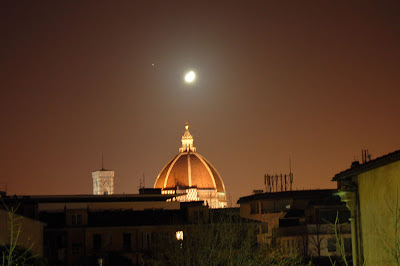


I don't know how we could top all that, frankly, so I am quite happy to revert to non-holiday mode. Frances talks, however, about going to India . . .

07 February, 2008

A Tiny Piece of Printed Ephemera

Frances had a very good (if totally exhausting) time at the Royal Academy Exhibition. I went up on the last day, met some great people and scooped her up with all the stuff and drove back home. I would love to say she could then rest but there was (and still is as I write!) the little matter of wrapping up and sending off parcels containing all the books that were ordered.

It really does, though, seem a good time to talk about something completely different!

* * * *

When faced with much typographical design today, especially of a commercial nature, I tend to get very humphey about bright young things who, finding that there are three hundred fonts in their design package, proceed to use every single one of them in a half-page ad.

I, as you may have noticed, almost always stick to one font (even eschewing Bold, which I hate) for any particular book and, although I have in my printing office many cases of carefully rescued printers flowers, rules, borders and so on, I almost never use any of them. For me, my favourite two colons and a space, used to divide something from something else, eg.


Author's name : : Book Title : : Publisher's Name

is as radical as I usually get!

The fruit salad approach so often to be found nowadays is not however restricted to the computer age . . . as this little offering demonstrates.

I had obtained a small picture (can't remember what) in a very grotty frame. Clearly this needed to be changed. Among the bits and pieces backing the picture was this small and incredibly flimsy slip of paper.


It could have been scrumpled up in less than a second and tossed away along with the other bits of grotty frame. Happily my eye focussed on it . . . just in time.

This piece of everyday Victoriana could have been some sort of poster or flyer but I feel it was more likely a paper bag or sheet of paper for wrapping purchases in. What is clear is that it constitutes a really fascinating piece of printed ephemera.

I love to imagine the compositor rushing with his composing stick from his stone to this case, and then that one and then yet another!

Give the photo a click and have a good look. At the last count, I found SIX different typefaces and SEVEN different rules and ornaments . . . all on half of a paper bag!

24 January, 2008

Thomas Hardy: Green Blades from Her Mound

We now have in our hands the first copy to be bound of our latest book so that we could photograph it and give its details before it goes into our website. The Fine Bookbindery have pulled out all the stops to get copies ready for our visit to London to show at the COVERED exhibition (Royal Academy, 6 Burlington Gardens, part of the Modern Works on Paper exhibition. For dates and details see below.)
More than half of the copies in the Special Edition are already spoken for and there are healthy sales of copies of the main edition - this from our early mentions of the book as it was in progress through the press. Publicity, in the form of a pdf, is on its way to those for whom we have email addresses but to order you only need to contact us by phone or email to be sure of a copy. Do visit us at the Royal Academy if you would like to see a copy before ordering.


Latest Publication from
The Old Stile Press
February, 2008

Green Blades

poems by Thomas Hardy

images by Mark Cazalet


Thomas Hardy’s wife Emma died in November 1912, in the attic room of their house where she had lived estranged from him. Their marriage had hardened into an empty shell and Hardy had long been in love with Florence Dugdale, whom he married the following year. However, on reading Emma’s secret memoirs detailing his cruelty and the breakdown of their marriage, Hardy was hit by an avalanche of grief. He returned to the north Cornish coast of their courtship and spent the rest of 1912 and 1913 producing his most lyrical and abiding collection of poetry.


Mark Cazalet has created images to act as visual equivalents for the extraordinary insights Hardy found in the depths of his experience, rather than attempting his topography or historical period. He arranged the sequence to suggest his gradual reconciliation to guilt and grief, resolving into a dawning sense of acceptance.
He was just completing the prints when Claire Tomalin’s recent book Thomas Hardy, The Time-Torn Man was published. Green Blades - as we have titled this selection - reflects what Claire Tomalin calls the ‘rediscovery of repressed sorrow and forgotten love’.


It was a long and painstaking task to cut wood and lino for the twenty-two large images and Mark was simultaneously working on huge murals, stained and engraved glass commissions and painting trips to Israel and Palestine for a magnificent series bringing stories from the Bible into the modern world. Each page opening involves text and image using three colours on characterful Italian white paper. The inks are specially mixed by Cranfield Colours from natural pigments. The binding has an image printed on the cover and then is surrounded by a cloth folding slipcase.


330 x 350mm. 48pp. Fabriano Tiziano paper. Centaur type. Each of the images is formed from one woodcut and one linocut and printed directly from the original blocks. Five colours are involved for which the inks were specially mixed by Cranfield Colours. Case-bound with printed paper cover and cloth-covered slipcase by The Fine Book Bindery, Wellingborough.


The Main Edition consists of 200 copies, numbered & signed by the artist. £275 (+ £5 p&p in UK. Overseas at cost)

The Special Edition has a copy of the book contained in a velvety-lined drop-back box together with a portfolio with five of the images from the book but printed and signed by the artist together with one other two-colour image that does not appear in the book. Only 10 copies for sale, numbered I-X. £650


Frances & Nicolas McDowall,
The Old Stile Press,
Catchmays Court,
Llandogo,
Monmouthshire NP25 4TN, UK.

13 January, 2008

Editing the Ice.


Yesterday the forecasters had offered us exactly half a day of sun after days of rain and before more days of the same. We, of course, rushed out to make best use of it, feeling a bit like the prisoners in Fidelio as they blunder and grope out into the light.

It was indeed a beautiful morning but I was not prepared to find much of the field between us and the river covered in what seemed like rather exquisite calligraphy. In fact of course the ground was waterlogged and the excess water had not yet seeped into the ground. These shallow puddles had frozen overnight and were now melting at such a speed that, had I turned up with my camera half an hour later, there would have been nothing to photograph.

How I love the patterns of Nature!


12 January, 2008

COVERED!


For the first time last year, a small number of Private Presses including The Old Stile Press, participated in the exhibition, Covered!, alongside art galleries showing paintings, drawings and prints at the Modern Works on Paper part of the Watercolours and Drawings Fair at The Royal Academy, in London.

The venture was a great success and is to be repeated from 31st January - 3 February 2008. Full details are given on this sheet (we hope a click will render it legible) and we are proud that Mark Cazalet's titlepage for Green Blades (which will be shown first at this Fair) was chosen to represent this part of the event. If any of our friends are able to attend the show, we can send them an 'Invitation'.