26 April, 2007

How I wish this book was one of ours! . . . 4


This book, being a straightforward trade children's book is a different thing completely from the special and wonderful books I have included before in this mini-series but anyone who has read our Bibliography or heard us speak will know much I love it and how strongly it influenced my decades as a book builder.


I see that it was published in the year I was born and I was given my copy quite soon afterwards. It was certainly a book that was read to me so that my eyes and my imagination were able to range freely across the landscapes on these pages and how much I loved doing that. I was captivated by the warmth and humour of the black and white drawings but I suppose it must have been unconsciously that I so valued the great areas of white space within them which added so much to their power rather than the reverse.

I was always especially fascinated by the great "O" on the initial page. I can vividly remember, without being able to explain it, my childish delight and love of this great sculptural shape which seemed to stand both as part of the line of text but also as part of the landscape - so drawing them together, I suppose.


This is not the place to recount the story in detail. If you have come across Ferdinand, you will know it off by heart and, if you have not, I can only hope that you can find a copy for yourselves. Suffice to say that Ferdinand is a little bull in Spain. In his field there are other child and adolescent bulls who love to rag around and fight each other and dream of being chosen for the bull-fight in Madrid. Ferdinand did not have any desire for this sort of behaviour but spent his time sitting under his favourite cork tree 'just smelling the flowers'.

At a very early age I realized that I WAS Ferdinand . . . going off by myself rather than rushing round with the others! That was the other reason for my love of this book but, for the moment I would just like to offer you some more of these incomparable drawings.


When the talent scouts arrive, Ferdinand goes off to his tree but unfortunately sits on a bee and is stung into great snortings and leapings about. The talent scouts immediately think he is the strongest and fiercest bull of all . . .


In the bull-ring, all the matadors and the picadors and so on march proudly round . . .


. . . and he ends up happily under his cork tree! Bliss.

I end with the wonderful endpaper drawing. This is the Spain that I have always looked for and how we laughed every time at the linguistic naughtiness of 'hot dogos' and 'chocolate baros'!


16 April, 2007

A Flowery Mead


Our mower is bust at the moment!

I hate to imagine how Autumn will bring sharp brambles to our upstairs windows as we two Sleeping Beauties are finally lost to the jungle all around . . . but, for the moment, the Spring has great charms to offer. Lady's Smock and Celandine, Bugle and Violet . . . a veritable flowery mead.


What a lovely phrase that is! It makes me think of Shakespeare and Spenser, the mediaeval garden . . . either the real thing or Pre-Raphaelite versions.

But, in the context of the present day, I immediately think of the paintings of our friend Clive Hicks-Jenkins. So often, if a bit of ground has to be depicted in one of his rich works, it is elevated to the status of a delicious 'flowery mead'. Here is one - a tiny detail from a large painting in acrylics and I happen to know that he is working on another at this very moment, in an even larger work which will be the centrepiece of his exhibition, later this year, at MOMA, Wales. I will be sure to give further details of this nearer the time.


For the moment, though, I would advocate a visit HERE, in a hunt for more flowery meads and so much more. The site is a lavish presentation of Clive's paintings and drawings . . . together, of course, with the books he has made with us!

15 April, 2007

Nd'A and God

We were unable to get to this launch, sadly, but I take this opportunity to urge anyone who has not yet seen this wonderful book to mend the situation asap!

Natalie d'Arbeloff's enterprise with The Old Stile Press has been mentioned on this Blog, together with images of the amazing one-off artist's book we had from her some time ago, but all that is just a drop in the ocean!

An exploratory trip to her website (see link) will undoubtably lead to regular return visits BUT, for now, I urge you to find out more about the entirely life-enhancing "The God Interviews" by going HERE.

14 April, 2007

Only there for a moment . . .


This photograph happens to bring together a number of things I like . . . especially paintings and photography and light and theatricality and recognizing that I must rush to do something (eg get my camera) NOW, or a moment will be lost for ever.

A painting by Michael Ayrton (a study for an enormous mural for the Festival of Britain) sat on an easel by the window. A glance showed that light was pouring in and the window itself was reflected in the picture glass together with part of a sculpture, by complete chance also by Michael Ayrton, which was on the other side of the room.

Happily, I think, I DID run for my camera!

06 April, 2007

An image for Good Friday

We have not been church-goers for many years but early memories are very powerful and the richness of Christian iconography, architecture, church music, painting and so on is extremely powerful. Of the piles of CDs in my printing office (see earlier photograph!) a high proportion are of church music.

Many years ago I found this piece of wood and hung it on an (outside) wall of our house - thinking that it looked quite like a dancer, or an angel or even . . .


As the years of rain and wind have lashed around in the courtyard in which the piece of wood hangs, it seems to have been changed, has become more stark. The soft tissues of the wood have washed or rotted away leaving the hard remains. It was always a lovely object but the passage of time has refined it, I feel, into something very special.


Welcome Blessed Spring.


As I was clicking the buttons for the greeting below, I suddenly remembered a similar year whose winter had (for me) not been up to much and the fact that I had produced the above as an act of rejoicement . . . using some wood letter that I had unearthed and as a first experiment of having more than one colour on the roller at the same time.

Happy Arrival of Spring!

. . . to anyone on this side of the globe, and commiserations to anyone who isn't!

03 April, 2007

Mozart and the Stone

This is a first experiment - after ages of frustration as described below!

If you go here, you can see it full-screen which is much better but you have to let it load sufficiently otherwise it stutters and breaks up.

With grateful acknowledgement and utter awe to Mozart.

Dedicated to Natalie d'Arbeloff, without whom . . .


Well, that was such fun . . . I must do another one!


02 April, 2007

April Moon's Fool


Someone told me that, if you cut a round hole in some blue-black material, draw a bit of a horizon line on it and put it up behind something in the foreground like a tree, it would photograph just like a full-moon coming up. Well, I tried and tried and got nowhere fast so . . . I went outside and photographed the real thing!

Sorry but that is the best I can do! We were so self-absorbed that neither of us even realized it was April 1st yesterday until the evening!

I have been indulging in much displacement activity recently. What I am avoiding is irrelevant. More to the point is that most of the time is going, going, gone at the computer . . . where I am seriously trying to come to terms with such undiscovered lands as iDVD, iMovie and suchlike and HOW on earth can one uplift an utterly brilliant and amazing little slideshow to blip.tv (or anywhere else, come to that) so that YOU can see it!! I sat in the sun all this morning reading manuals and STILL cannot get the thing to work!

And I just know you are all quite unable to settle to your lives for waiting for it . . .

Sorry, again. This joke has gone far enough as well . . .

It's just the fact that we discover that this BLOG is already being read IN FOUR CONTINENTS. It has rather gone to my head . . .

Anyone out there in Africa??

29 March, 2007

a day or two at the seaside . . .

We popped down to our favourite part of Pembrokeshire at the beginning of this week. Partly business of a sort but we did get down to the sea . . . and enjoyed some unexpectedly glorious sun. I really DO love just walking and looking but I cannot resist searching for treasures, sometimes actual stones, shells or ROCKS if I am not restrained, but increasingly with a camera. The following glories were all captured within a range of about 100 feet. Maybe more to come!


24 March, 2007

p.s. to the flood

Knowing, as I do, that half the world is agog to discover every feature and happening of 'our' river, I felt that I must waste a moment of your time with the following!

This photograph, and the one below, have little point without my stating 1: this dead tree is so heavy that Frances and I together cannot move it, 2: it was brought here and plonked down just where it is . . . by the flood water, 3: talking of water, the river when I took this photo was showing how it normally is at a lowish point of the tide.

Given that a tree of this weight would need quite a depth of water to float in freely, I reckon it must have been between five and six metres higher than it was for the photos.

There, I said you'd be interested!

15 March, 2007

In the Printing Office . . .

. . . things are beginning to bubble up nicely! At the beginning of work on any book it seems that weeks if not months of solid work go by and nothing seems to have been achieved. I print text on one side of a sheet but I know that that sheet must have text on the other side and then two (or sometimes four or six) further printings of blocks before that sheet is finished.


With the sheet in this photograph, I have at last reached that point. There is already text and imagery on the other side so, after these final images have dried, the sheet will be ready to be guillotined and then folded and collated with the other signatures to form the final book. When this point is reached, each day is likely to produce another sheet ready to be passed over to Frances for these final rites - including, we hope, the weeding out of any sheet that has acquired somehow an inky fingermark from the printer, although I rather think that these should be charged extra for!


This book is the wonderfully erotic poem, Black Marigolds, translated by E. Powys Mathers from the Sanskrit. The images are by Glenys Cour whose work for Vernon Watkins' Taliesin and the Mockers has been so much admired. The technique (although subject matter and format of book give a quite different feel this time) is the same as in the earlier book . . . collages of black and white paper and white paper given a patterning in black by such techniques as monotype, stippling and so on. In the photograph above, Glenys' original collage is on the right while my printing is on the left, with a verse of the poem. The gold-coloured thing above is the photo-polymer block which I made from the original and with which I printed my version.

While taking these photos, I suddenly thought that I would give to the world an uncensored view of the environment in which I work! At the start of a new book-building project I do start off with a clear table and most things 'put away'. As the process continues, tools and other things are laid out and must fall under the hand when needed again. I am sure it will be clear to all that everything in these photographs is exactly where it should be and any misguided tidying-up would be completely disastrous.

I have sometimes been shown into printing offices which look more like operating theatres or smart Show Houses than anything I would recognize as a place I could inhabit for many hours each day. In fact such places really give me the willies!


In the background of this other photograph (below) is my guillotine - made at the turn of the (previous!) century and still going perfectly. All it needs is a really sharp blade and a strongish arm to turn the handle. It is, incidentally, totally without safely features of any kind. 'Health and Safety' addicts would get the vapours just to look at it! If I, alone, use it then that is legally OK. If anyone else was to use it, however, I could be had up immediately. Hence (as all my other machinery is of similar vintage and degree of lethality) we can allow no assistants, students or helpers of any other sort.


If cars 'run' on petrol and sheep on grass, I 'run' on music! My cordless headphones are on all the time and there is always a CD somewhere that will answer my mood!


Back, finally, to the work in hand . . . an opportunity to compare more closely the original against what the process-camera 'saw' and what the block made of it.


13 March, 2007

Harry Brockway: Sculptor & Wood Engraver


As a recent visit here allowed me to take a photograph of our long-standing friend, Harry Brockway, I thought I would embarrass him by putting up a selection of lovely things that he has done for and with us over the years.

When you see examples of his work in his two media side by side, the style and particular character of the artist is clearly present in both and is of the same order . . . and yet some people appear surprised that the engraver is also a sculptor and vice versa.

There are, happily for us, 'signs of Harry' all around us. As you enter our domain, it is Harry who confirms that you have reached the right place. Below this elegant letter-cutting there is also our press-mark carved but the undergrowth seems to have taken it over!


When this fountain 'mask' was being thought about, I felt it would be fun if it could be seen as a combination between a 'green man' and one of those winged putti who pout their lips to blow winds from appropriate directions on ancient maps. Harry got the idea perfectly and a good number of years have given a wonderfully ancient and, yes, romantic feel!


The deliciously carved figure below is an early work and it has been with us decades. It is a full-length figure though less than life size. The dress is simply the wood painted white.

You may be able to see, incidentally, tucked between the uplifted arm and her cheek, a small tube like object. This has nothing to do with Harry but has a rather enchanting history. Many years ago Matilda (then about 10), the daughter of Sara Philpott (but that's a whole different story! See here and here ), came with her family to spend a summer day with us. We heard later that she had been a bit shy to say to us how much she had enjoyed the time so she took a piece of 'paper' from a paper-bark maple in the garden, wrote a sweet note on it and slipped it into the safekeeping of Harry's figure. It is, of course, still there carefully preserved in its niche!


The Lad Philisides
has always been a special favourite of mine. In the planning stages, we looked together at wood engravings and etchings by Blake, Samuel Palmer and, particularly, Edward Calvert and also some of the contemporary and near contemporary followers, such as Robin Tanner, Paul Drury and my favourite neo-romantic painters. How well Harry got into the spirit of these artists when it came to these poems by Sir Philip Sidney.


There are, I think, just two or three copies of this delicious book left - though I have to confess that I am staggered that they have survived thus far!

Harry's second book with us, Faithful John was much later and there are also copies of this remaining - even some of the Special Edition, I believe. His treatment of this powerful and resonant fairy-tale continues to amaze me for its technique as for its content. Not everyone knows that we started with the 'challenge' of him designing and engraving (and me incorporating into a page design) these bizarrely shaped blocks which in fact remained to him after stock-sized blocks had been cut down to size for one of Harry's many commissions by the Folio Society. Constraints always make for excitement.


We are in the process of trying to plan another project together. I cannot wait!


06 March, 2007

It's been raining a bit in Wales . . .

. . . so we're a little flooded. Happens each year (more with global warming, no doubt!) and does not matter to us for the good old builders of our house built it safely up the side of the valley rather than in the flood plain which seems to have been the fashion among imbecile planners in the UK for many a year.

It is quite dramatic, though. What those of you who have not yet come to visit us and seen the Wye in its detumescent state, as it were, have to realize is that the trees you can see in both of these photos - the ones which are sticking up out of the water - these are all on OUR side of the river.

The strange terracotta colour of the water is also absolutely genuine. The river has a normal colour at normal times but lots of rain brings mud from the fields of Gloucestershire into the river Lugg (how anglo-saxon can you get!) which is a tributary of the Wye and thence past us and into the sea at Chepstow.

There is no reason whatever for posting all this. I do it simply because I am taking the greatest delight in being able to! The fact that I can take some photos this morning, fiddle a bit on the computer and then friendly blog-followers in Orkney (hello Norman!) or Australia (hello Guy!), or wherever, can know precise, if totally unimportant, details about our lives as if they lived next door . . . is just fun and friendly and generally life-enhancing!

26 February, 2007

Back from San Francisco!

Hi! This is Frances, for a change.
You might get the idea from all the swans and sheep that life is rural and gentle at The Old Stile Press. However, this last month has been hectic and full of contrasts for me. First, the Works on Paper Fair at the Royal Academy where we met an amazing number of people, most of whom were unfamiliar with the book as art, or even a repository for art. For a long time we have endeavoured to find opportunities for our books to be seen together with works of art not just among books and this proved to be all that we had hoped. Many of the visitors to the fair were hugely excited by the books they encountered (not just ours) and bought enthusiastically. The logistics of getting ourselves and books to central London at short notice and then staying for five days took some considerable effort and then back to base to spend a day wrapping and despatching a large number of parcels before setting off to California. So I set off on a high, though exhausted.

I should have known - but it was nevertheless unexpected - I left Britain in snow ( and Nicolas has some horror stories involving being snowed in at home alone, fallen trees and chainsaws) and arrived in California in rain. When it rains there, it really rains although it had waited for two dry months to tip it all down on my head! My destination was Berkeley (the University Campus was alive with anti-war protests, drumming and singing in the main plaza) where printers, book makers, librarians, collectors were coming together for a symposium and book fair for four days prior to the world famous San Francisco Antiquarian Book Fair. The contrast was great and discussions changed gear because all these folk were deep into books, their history, the way they are produced, presses and the intricacies of their productions. The way they all looked at books was so different from the buzz generated at the Academy. That is not to say there was no buzz here too but of a very different nature. Many of the books produced by Californian artists explore structures and are many layered in terms of imagery and printing method - often startling and eye-catching and make our books seem very cool and spacious. At first I thought this was going to mean that no-one would choose to buy from us - however, on the third day that changed and we sold to some very enthusiastic people. During the course of the event, however, I had the pleasure of meeting librarians and collectors who had previously only been august names.

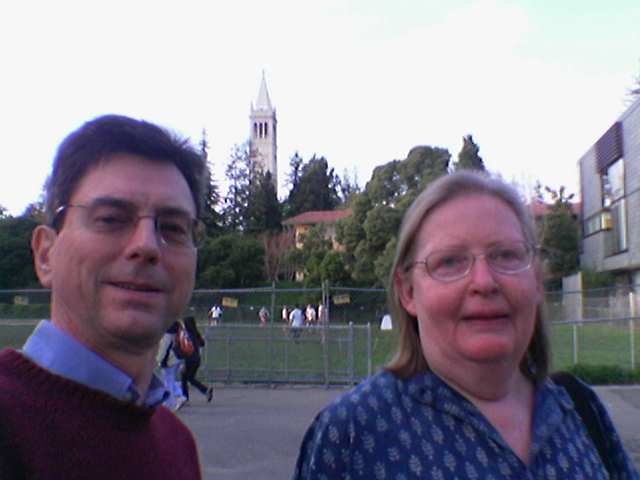
Martyn Ould's mobile phone captured this shot of us with the Berkeley Campanile behind us - he was showing his Old School Press books and there were six other British presses who made it over to California. In all, there were about a hundred presses showing their books, with a sprinkling of papermakers and leather suppliers for bookbinding. It was a remarkable gathering and evidence of a healthy interest in the creation of books - but one of the questions posed was whether an art is dead if it is only appreciated and bought by its creators. The works shown would certainly demonstrate vitality in the huge variety of approach to the creation of books. Coincidentally, the vitality is best demonstrated by the much greater interest shown in books at the Royal Academy show where the buyers were certainly not makers. They did, indeed, find it of added interest to meet the makers rather than the more accustomed (in that context) gallery owners.


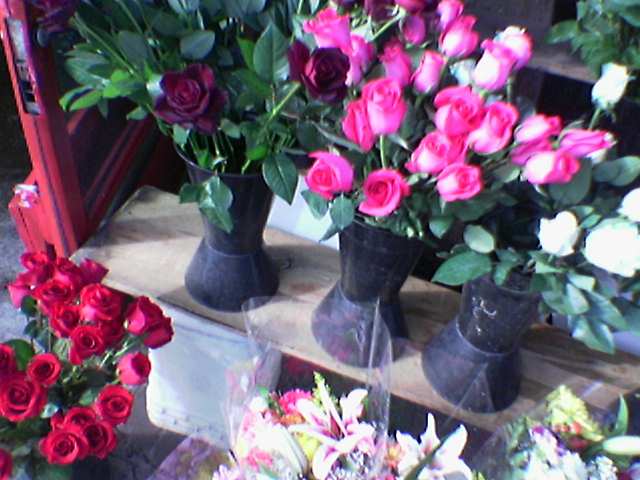
Valentine's Day found Berkeley awash in flowers - everyone seemed to be giving and receiving bunches of roses, or a single flower . . . no more the faltering anonymous card sent to the seemingly unattainable person of one's dreams. Far distant from our partners, Martyn and I had the brilliant thought of taking a photo which could be sent by e-mail to each partner. N had the effrontery to wonder if the roses were on a garage forecourt - hey, they were the most flamboyant in town! Having said that, the flower shops themselves were not what astounded me, but the green of Berkeley and the profusion of growth. Yes, there were daffodils, primula and tulips but also arum lilies, agapanthus, roses, caeanothus all of which grow almost wild on the hillsides and huge Magnolia grandiflora, eucalyptus and pines - how do they know what season it is there! I managed a trip around the bay to see the skyline of San Francisco and its bridges. The photograph might seem stagy but it really was that glowing orangey-red with dark outlines of bridges and islands and distant mountains. Overwhelming, especially on top of such an outpouring of books and conversations with the people who made them . . . at breakfast and every moment throughout the day!


12 February, 2007

How I wish this book was one of ours! . . . 3


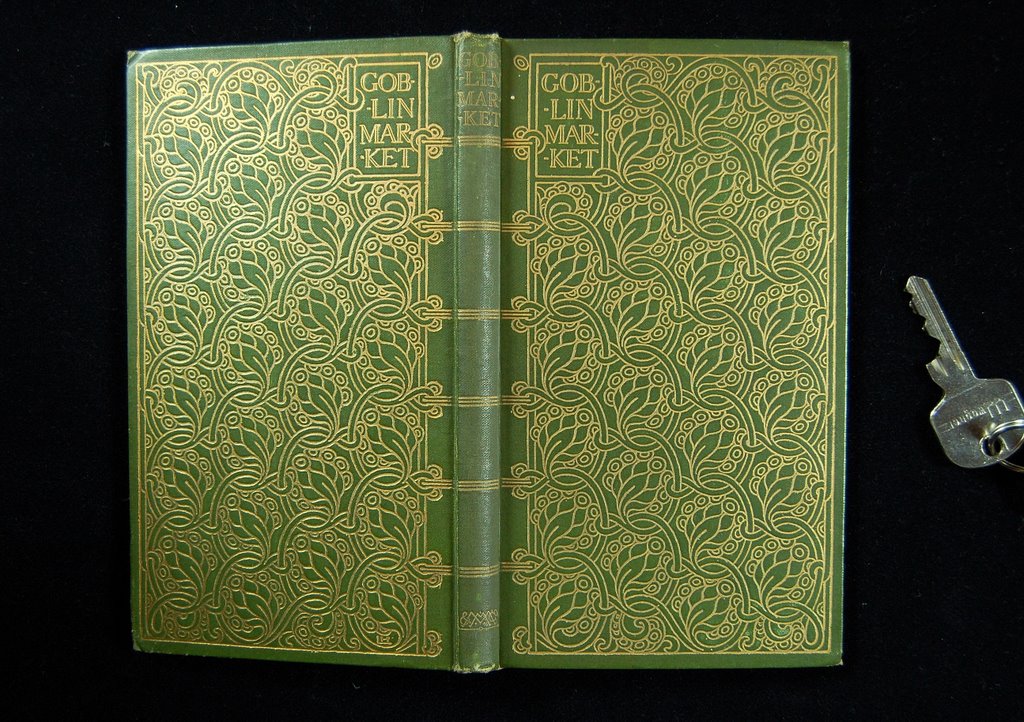
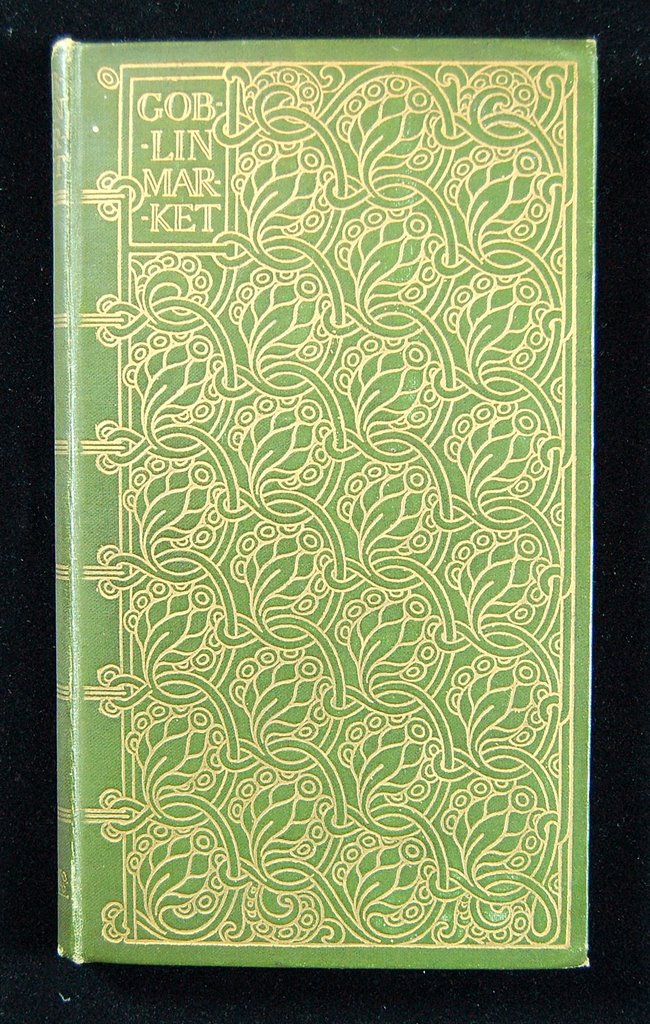
This is one of the most entrancing books I have ever held in my hands. I put it like that because it is really is delicious to hold. It is smallish, as my comparison shows, but is by no means a miniature. It also delights in the tall format that has been a great favourite of mine for as long as I can remember.


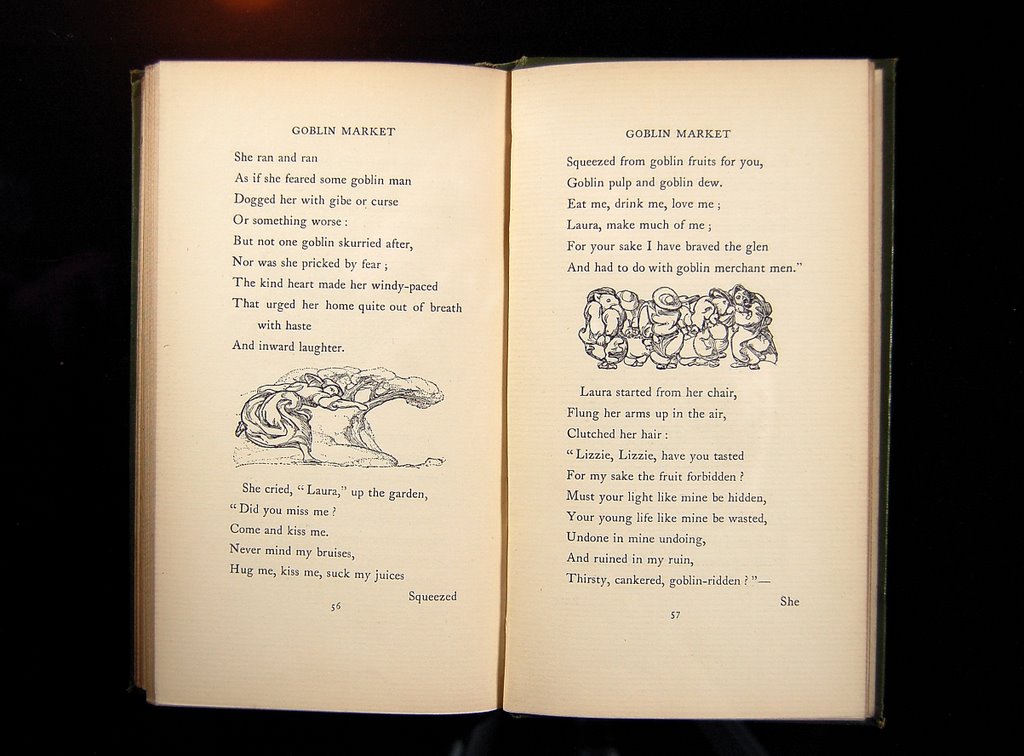
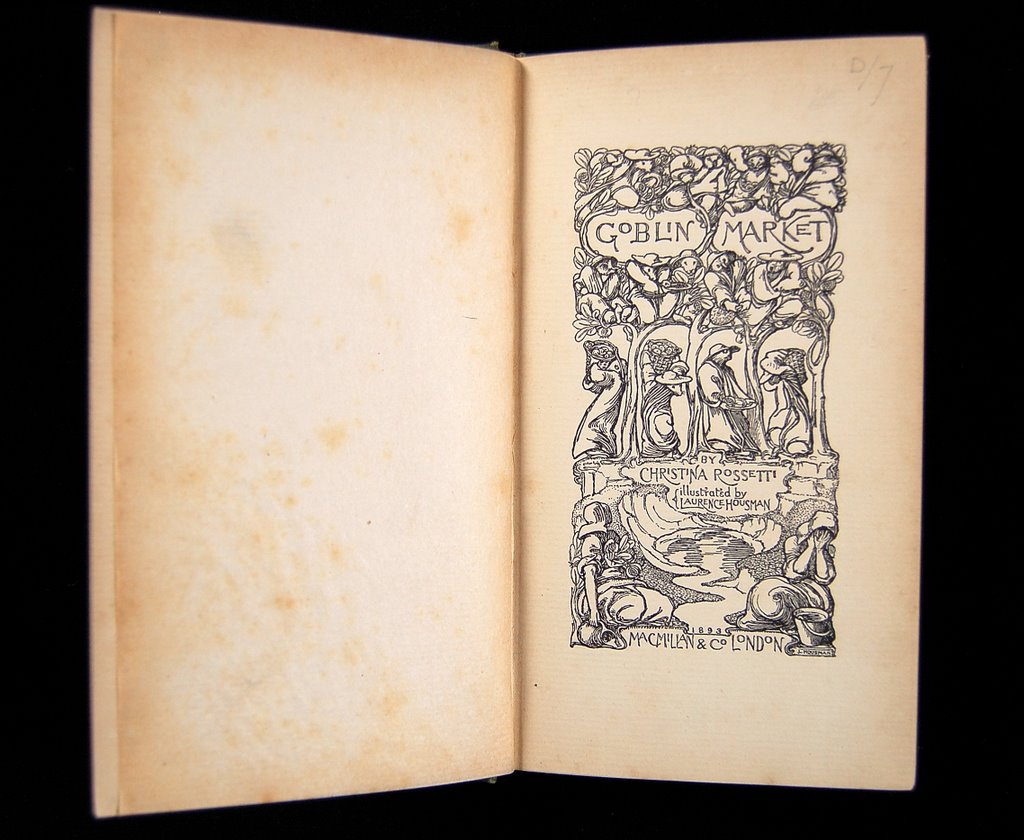
It is an edition, published by Macmillan in 1896, of Christina Rossetti's weird and haunting poem, Goblin Market. The wood engravings were designed by Laurence Housman but were actually engraved on to the wood, and with the greatest skill, by his sister Clemence Housman.


A quick glance shows that the artist was not just doing a number of pictures to be handed over and popped into the publishers' book by a workaday printer. Rather, it is clear that Housman was entirely responsible for every single detail of the book's design and physical make-up (even though it was never anything other than a 'trade edition') and contemplation of this fact and the wonderful result of such 'oneness' of purpose has been a tremendous inspiration for my attempts to 'go and do likewise' at the OSP.

The richly gold-blocked cover, front AND back, makes the book, as it nestles in the hand, seem like some rare decorated treasure . . . but the repeated pattern is actually straightforward and 'wholesome' rather than over-wrought and leads seamlessly into style of the imagery within.


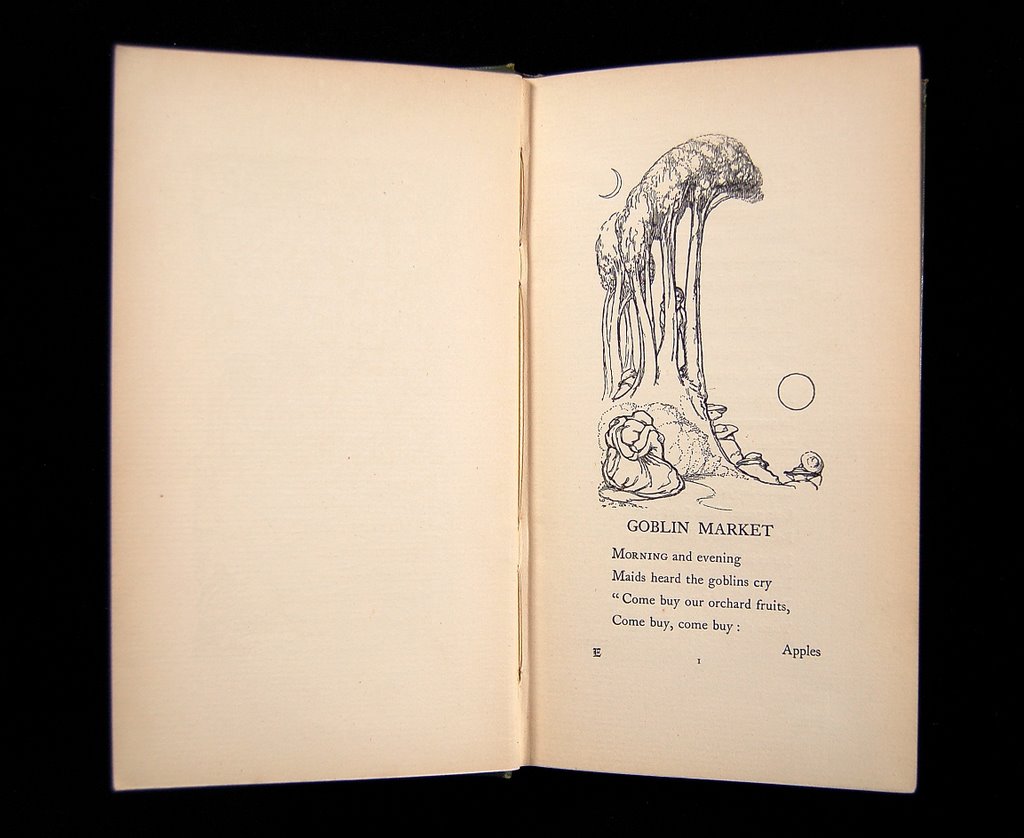
The titlepage is deliciously detailed but it is the next opening - the first page of the text - which takes my breath away and seems to sum up all that I am trying to bring to our books.


How daring . . . just the title and four lines on this page but with an image which seems to sum up completely the atmosphere in which the story is to be told in the same way that a painted gauze can prepare the audience for what an opera or ballet is about to describe. The image is not particularly large of course but it has been completely released from any box-shape or framing square. Its energies rush out and inhabit all of the space offered by that whole spread. Sun and sickle moon we see . . . and think of Samuel Palmer, the other Ancients and all the tradition down to the Neo-Romantics whose work I love so much. Almost a cliche already, but I don't care!


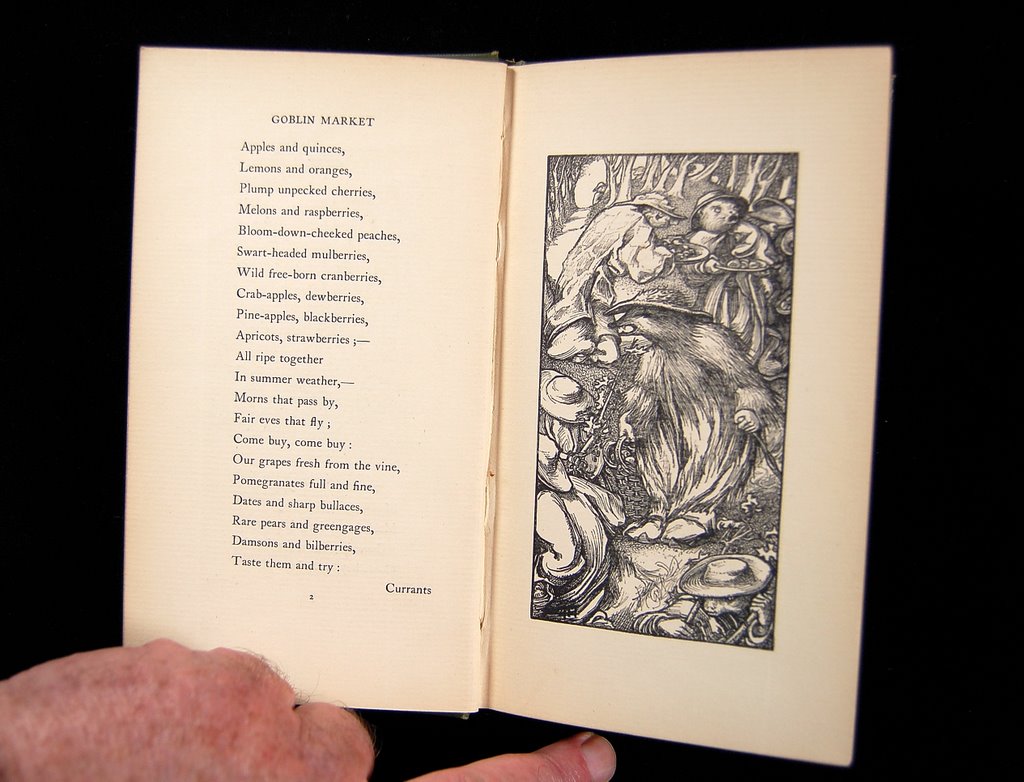
Through the book there are a number of single page engravings (which face a page of text) and a number of small vignettes which punctuate the text, as you can see above. Most amazing of all, though, are the pairs of mighty engravings which are separated from each other by the book's gutter but which actually form a single image.


What a glorious treasure!